Kinnaur, Aug 1 — Cross-border trade through the Shipki-La route in Himachal Pradesh's Kinnaur district restarted on Saturday after being suspended for nearly six to seven years, officials said. The revival was formally inaugurated by Himachal Pradesh Revenue and Horticulture Minister Jagat Singh Negi, who also flagged off the first group of traders.
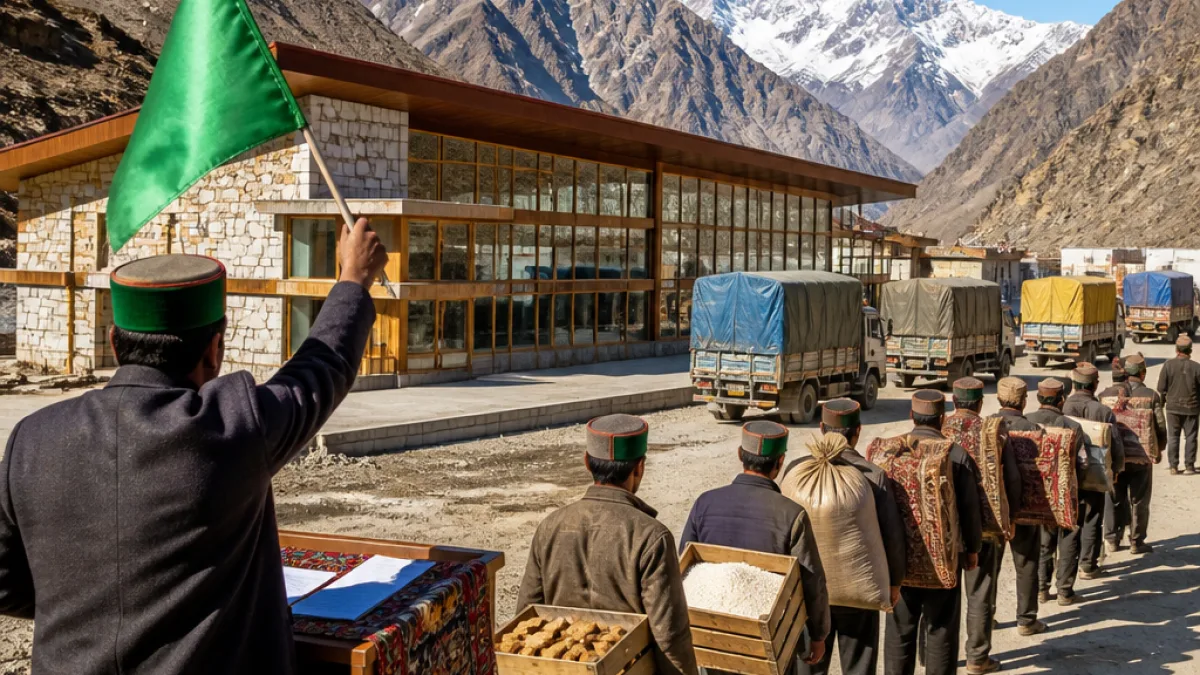
Opening ceremony and first consignments
The district administration said a contingent of 16 local traders from the villages of Namgya, Dubling and Leo was sent across for commerce with China-occupied Tibet. The traders carried a range of notified goods including jaggery, rice, tea, sugar, carpets, local grains and biscuits.
"Earlier traders from Kinnaur had to travel to distant locations in Tibet for business, but the newly developed trade centre at Shipki village would now facilitate exchange of goods between traders of both countries at a single designated location," Negi said.
Before departure the traders were honoured with traditional Khata scarves. The administration said all security clearances and background verifications had been completed, and traders were instructed to return within 72 hours in line with prescribed guidelines.
New Trade Mart, costs and facilities
The minister inaugurated a modern Trade Mart at Shipki village which, according to officials, was constructed at a cost of ₹1.70 crore. The centre is intended to be the single designated point for exchanges, removing the need for local merchants to travel deep into Tibet for markets.
District officials indicated that the trade mart will serve several immediate functions:
- Host and administrate cross-border transactions at a single location;
- Provide security and clearance points for traders;
- Facilitate inspection, weighing and temporary storage of notified goods.
Regulations and notified goods
The resumption will operate under rules framed by central agencies. The district administration said the Directorate General of Foreign Trade (DGFT), the Ministry of Commerce and the Customs Department have provided a notified list of permitted goods. Under this framework:
| Direction | No. of permitted categories |
|---|---|
| Exports from India to China | 36 |
| Imports from China to India | 20 |
Officials added that quarantine facilities for livestock trade remain pending and will be addressed as per applicable veterinary and quarantine norms before any live-animal movement is permitted.
Local economic impact and context
Administrators and local representatives view the revival as a potential boost to border livelihoods, transport services and associated businesses. Kinnaur’s remote villages have limited market access; proximity to a designated trading point is expected to reduce travel time and transaction costs for small traders and producers.
Local economies in the high-altitude border belt largely depend on horticulture, small-scale trade and movement of essential goods. Officials said the central government’s facilitation was acknowledged during the inauguration for enabling the route’s reopening after the suspension following the COVID-19 pandemic.
Security and procedural measures
The district administration emphasised that resumption followed completion of necessary security screening and administrative clearances. Traders will be subject to the 72-hour return window and other procedural constraints set by border management agencies.
Authorities said they will monitor initial consignments and operations closely and make adjustments to logistics or procedures if required. The Trade Mart is expected to play a key role in streamlining inspections and customs-related formalities at the local level.
As trade resumes, officials and residents will be watching both for immediate economic benefits and for how regulatory, quarantine and security requirements are administered in practice at this sensitive border location.
Vikas Thakur | Correspondent