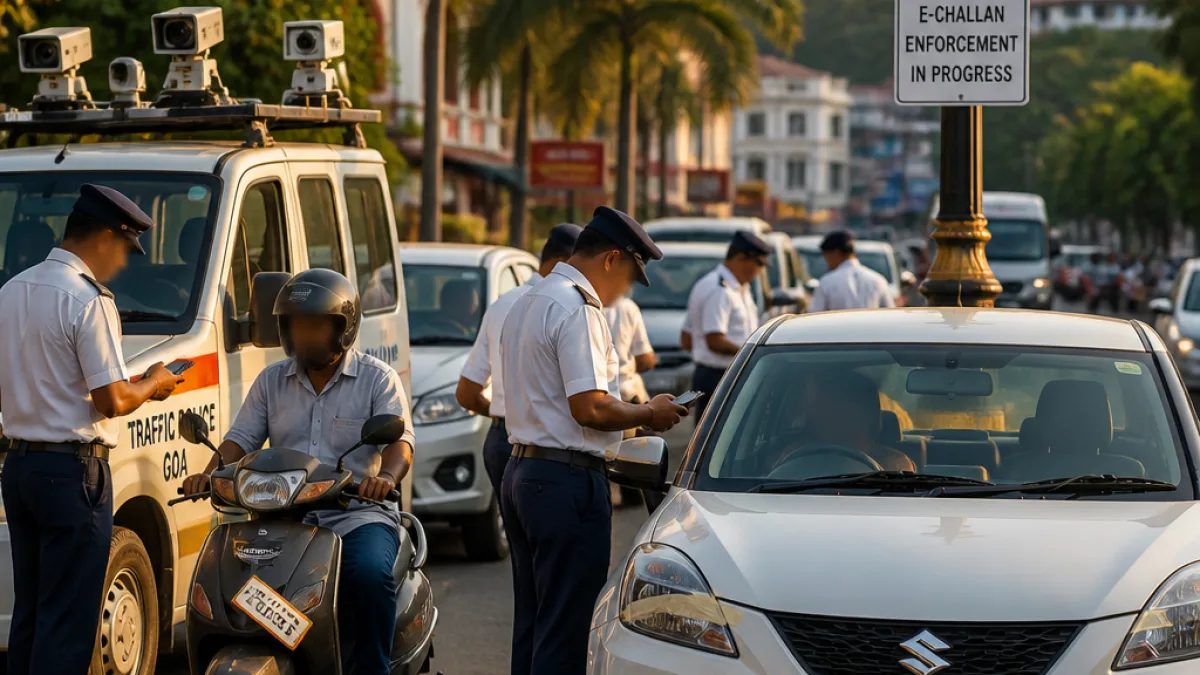
PANAJI: The Goa government has taken a firm stance against motorists who attempt to thwart its newly operational AI‑based traffic surveillance by concealing or damaging vehicle registration plates, warning that such offences may attract a suspension of the vehicle's Registration Certificate (RC) for a minimum of three months in addition to statutory penalties.
Enforcement steps after e‑challans go live
The enhanced enforcement follows the rollout of e‑challans for all Phase‑I traffic violations from 1 August. Senior officials said that, after the automated system became fully functional, some drivers and riders tried to avoid camera detection by removing, defacing, or obscuring number plates. Enforcement teams from the Traffic Police and the Regional Transport Office (RTO) have responded with targeted drives.
An official involved in the operation said the drives have targeted not only vehicles sporting unauthorised novelty plates but also those deliberately concealing or mutilating registration plates. Vehicles found plying without plates are being intercepted and penalised, and authorities have warned of stricter penalties going forward.
"The Traffic Police and Regional Transport Office officials have already launched enforcement drives penalising not only vehicles with illegal fancy number plates but also those deliberately concealing or defacing registration plates... We will get stricter by suspending RCs for a minimum of three months," an official said.
Impact on road‑user behaviour
Officials reported that the AI initiative has produced a marked reduction in traffic violations. Daily offences dropped substantially from the roughly 52,000 incidents recorded in June, according to the source. Authorities said the machines and the backend e‑challan system are delivering the behavioural change the project targeted.
Nevertheless, some non‑compliant practices remain common. Riding without helmets and failure to wear seat belts continue to top the list of offences, though officials said compliance on several fronts has improved markedly.
| Metric | Reported figure |
|---|---|
| Daily violations (June) | ~52,000 |
| Estimated rise in compliance (since two months back) | ~80% |
Priority offences and public safety
Officials highlighted that, despite improvements in areas such as documentation and insurance adherence, basic safety lapses remain a major concern. They stressed the link between not using protective gear and higher fatality rates in road accidents.
Retired Supreme Court judge Abhay Manohar Sapre, who heads the Supreme Court Committee on Road Safety, urged firm enforcement of helmet and seat‑belt rules. Officials said most fatalities recorded on roads are avoidable when mandatory safety measures are observed.
- Primary offences picked up by AI: riding without helmet, driving without seat belt
- Other enforcement areas: insurance and mandatory vehicle documentation
- Sanction under consideration: minimum three‑month RC suspension for deliberate plate tampering
Practical implications for motorists
Motorists should ensure registration plates are displayed clearly and conform to legal specifications. The crackdown addresses both aesthetic customisations that violate norms and deliberate efforts to obscure plates to evade automated detection. Those intercepted could face fines and administrative action affecting their RC.
Traffic authorities have indicated that routine patrols and manual checks will continue alongside automated monitoring. The combined approach is intended to sustain the recent gains in compliance while deterring evasive tactics.
Looking ahead
Authorities said they will continue to monitor trends and calibrate penalties and enforcement tactics as required. The government’s message is clear: attempts to subvert AI surveillance by tampering with plates will attract punitive administrative action, including the prospect of temporary RC suspension, to reinforce road safety objectives.
Motorists are advised to follow vehicle display rules and basic safety regulations to avoid fines and administrative sanctions and to reduce the risk of serious injury in the event of accidents.