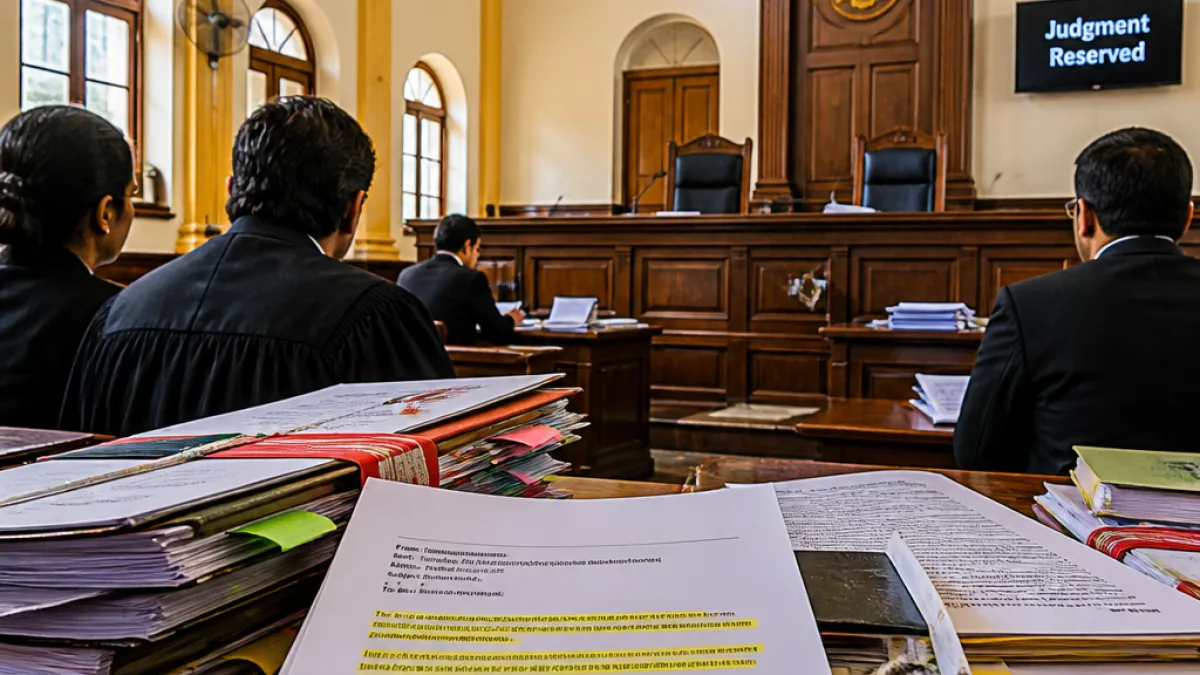
Panaji: The Goa bench of the Bombay High Court on Thursday reserved its order on the Goa government's appeal challenging the acquittal of journalist Tarun Tejpal in a sexual assault matter arising from 2013, after hearing final arguments that centred on whether an apology email from Tejpal amounted to an admission that a physical encounter had taken place.
Arguments focus on interpretation of apology email
A Division Bench of Justices Dr Neela Gokhale and Amit Jamsandekar heard submissions from Solicitor General Tushar Mehta, representing the Goa government, and senior advocate Abad Ponda, appearing for Tejpal, before reserving judgment. The court did not indicate when it would pronounce the verdict.
The legal debate at the hearing largely revolved around whether the message sent by Tejpal — described in court records as an ‘‘apology mail’’ — should be read as acknowledging a physical act or whether it referred only to a sexual conversation. Counsel for the state urged the bench to treat the email as an admission material to the criminal charge; defence counsel disputed that characterisation.
State counsel criticises trial court's approach to complainant's conduct
Opening his rejoinder, Solicitor General Mehta criticised the trial court’s assessment of the complainant’s conduct, saying the sessions court had evaluated her behaviour against an assumed model of how a victim should react. Mehta submitted that the trial court was wrong to set down rigid expectations about victims’ conduct and to discredit allegations because the complainant did not conform to stereotypical behaviour.
"My primary objection is to the way in which the trial court has examined the entire matter as if it is setting down a model code of conduct on how the victim should behave and if the victim does not behave in this way, then it is not right," Mehta said, according to court records.
He further argued that reactions of victims differ according to background, education and circumstances, and that courts cannot reject allegations purely because response patterns vary. Mehta also contended that the complainant’s continued professional activity after the alleged incident — in her capacity as a journalist — could not be used to undermine her credibility.
Background: acquittal and appeal
Tejpal, the former editor-in-chief of news magazine Tehelka, was acquitted by a sessions court in Goa in May 2021. The Goa government filed an appeal in the Bombay High Court challenging that acquittal. The present hearing before the Goa bench addressed the state’s contention that the trial court erred in its assessment of evidence, including the apology email and the conduct of the complainant, and in evaluating testimony.
The case has attracted significant attention given the parties involved and the wider public discussion on responses to sexual violence allegations and evidence appraisal by courts.
What to expect next
With the courtroom reserved, the High Court will deliver its order at a later date. The bench did not provide a timeline. Depending on the direction of the judgment, the matter could either result in the acquittal being upheld or in the trial court’s order being set aside and the matter remitted for further proceedings or conviction, if the High Court finds fault with the earlier evaluation.
- Key dates:
- 2013: Alleged incident that led to FIR and charges.
- May 2021: Sessions court in Goa acquits Tarun Tejpal.
- July 30, 2026: Bombay High Court (Goa bench) reserves judgment on the state’s appeal.
| Date | Event |
|---|---|
| 2013 | Alleged incident reported; criminal proceedings initiated |
| May 2021 | Sessions court in Goa acquits Tarun Tejpal |
| 30 July 2026 | Bombay High Court (Goa bench) reserves order on state’s appeal |
The legal issues flagged in the hearing underscore wider questions about assessment of documentary admissions, witness credibility and the contours of victim behaviour in sexual offence cases. Observers note that higher courts often examine whether trial courts have applied appropriate legal principles when evaluating evidence and conduct.
The reserve of judgment means parties and interested observers will await the bench’s written order to understand how the High Court resolves the contested evidentiary and legal points.
Reporting for this account relied on proceedings and submissions placed before the court and on official statements made during the hearing.