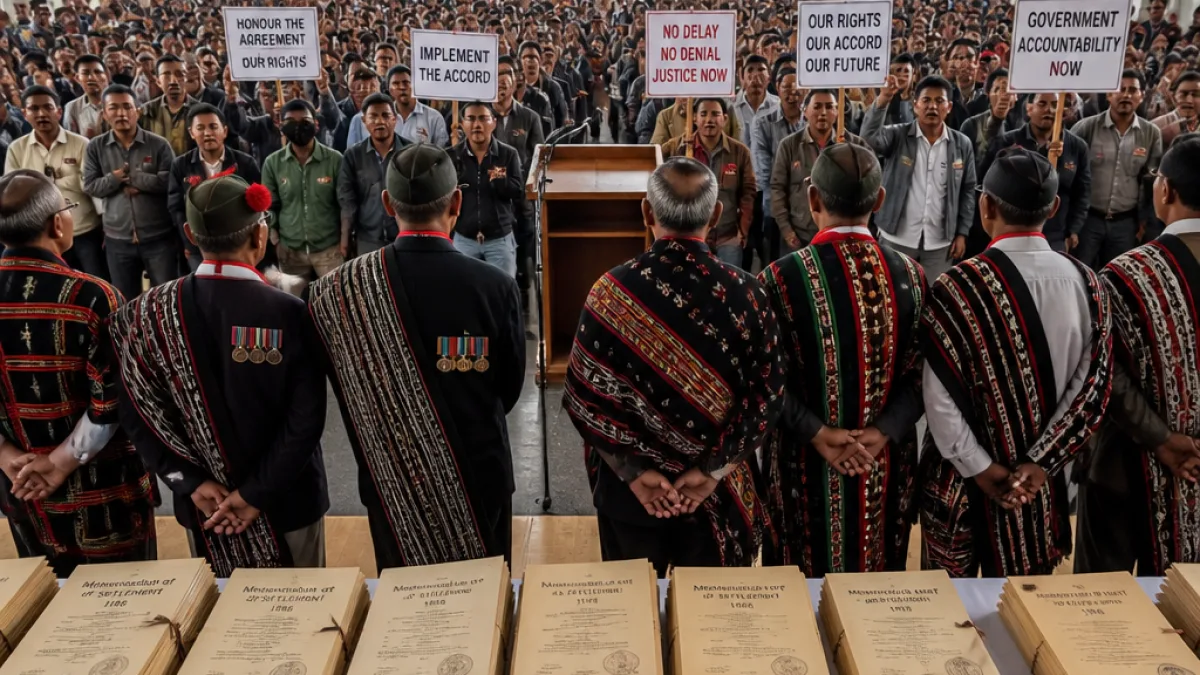
AIZAWL: Two associations representing former Mizo National Front (MNF) fighters on Saturday accused Chief Minister Lalduhoma of misrepresenting the 1986 peace settlement and belittling the safeguards that, they said, were secured after the sacrifice of many lives.
Former fighters reject CM's characterisation of the accord
Leaders of the Coordination Committee on Ex‑Mizo National Army and the Peace Accord MNF Returnees Association held a joint press conference in Aizawl to protest what they described as repeated statements by Lalduhoma that undermine the Memorandum of Settlement reached in 1986.
Vanlalbia, who chairs the Coordination Committee on Ex‑Mizo National Army, said the accord brought peace to Mizoram and that its gains are being enjoyed by the people. He accused the Chief Minister of making comments that, in his view, reduce the document's importance and misstate its legal nature.
Dispute over terminology and signatories
According to the associations, Lalduhoma allegedly told students at Mizoram Law College on July 31 that calling the instrument the "Mizoram Accord" was technically inaccurate because it was signed between the Union Ministry of Home Affairs and the MNF rather than between the Government of India and the state of Mizoram. The former fighters also criticised the Chief Minister for reportedly referring to the settlement as a "Memorandum of Agreement" and as a "Memorandum of Understanding," descriptions the associations said were erroneous.
Rejecting those characterisations, Vanlalbia pointed to the paper trail and the signatures on the settlement, emphasising that it bears the names of the MNF leader Laldenga, then Union Home Secretary KD Pradhan for the Union government, and Lalkhama as chief secretary for the Mizoram government.
"If the Chief Minister cannot properly understand or utilise the Peace Accord, and cannot safeguard it, he should hand over the power he currently holds to others,"
Vanlalbia read the statement calling on Lalduhoma to relinquish power if he was unable to protect the accord and its provisions.
Inner Line Permit comments draw further ire
The associations also objected to the Chief Minister's reported remarks about the Inner Line Permit (ILP) system, saying he presented it as a scheme the Centre could remove at its discretion. They argued such an assertion diminishes the protections and autonomy that, they said, were won through the settlement and subsequent safeguards.
- Who spoke: Coordination Committee on Ex‑Mizo National Army; Peace Accord MNF Returnees Association (chair: Vanlalbia).
- Alleged remarks by CM: Technical inaccuracy of the term "Mizoram Accord"; alternative labels for the settlement; characterisation of ILP as removable by Centre.
- Associations' stance: The settlement brought peace; its signatories include the MNF leader, Union Home Secretary, and the Mizoram chief secretary; CM should step down if unable to safeguard the pact.
Context and local sensitivity
The 1986 settlement ended a prolonged insurgency and remains a central element in Mizoram's political and social narrative. Veterans' groups and communities that endured the conflict typically treat references to the accord and to attendant protections, such as ILP arrangements, as sensitive matters. Any suggestion that these instruments are mischaracterised or vulnerable to unilateral change attracts strong reactions.
While the associations focused on details of wording and signatories, the dispute underscores broader anxieties about the future of safeguards perceived to protect local interests and identity. The ILP system, in particular, is considered by many in the Northeast to be a tool for regulating entry and preserving demographic balance; comments implying its discretionary removal by the Centre are likely to raise concern among stakeholders.
Political implications
The confrontation between ex‑MNF fighters and the state chief minister carries political weight. The former fighters' organisations are composed of people closely linked to the original MNF movement and its post‑conflict reintegration. Their criticism may resonate within sections of the electorate and among political actors who view the settlement as foundational to Mizoram's present political structure.
At the same time, Lalduhoma's alleged comments as recounted by the associations open space for clarification or rebuttal from the Chief Minister's office. The associations have framed their demand starkly: if the Chief Minister cannot or will not defend the settlement as they understand it, they say he should step aside.
What comes next
The associations have lodged a public complaint and sought a formal response. It remains to be seen whether Lalduhoma will address the specific points raised about the wording and signatories of the 1986 settlement or whether the matter will prompt mediation by other political or civil bodies in the state. For now, the disagreement highlights continuing sensitivities around the accord and the preservation of arrangements considered crucial to peace and local autonomy.
| Document | Signatories (as cited) |
|---|---|
| Memorandum of Settlement (1986) | Laldenga (MNF); KD Pradhan (Union Home Secretary); Lalkhama (Mizoram chief secretary) |