Raipur: Chhattisgarh Chief Minister Vishnu Deo Sai called on Prime Minister Narendra Modi at Parliament House on Friday and pressed for Centre’s support for three major state proposals — a gas-based urea plant in Rajnandgaon, grid electrification of remote Bastar habitations and the setting up of an All India Institute of Ayurveda (AIIA) in the state.
Major project proposals flagged to the Centre
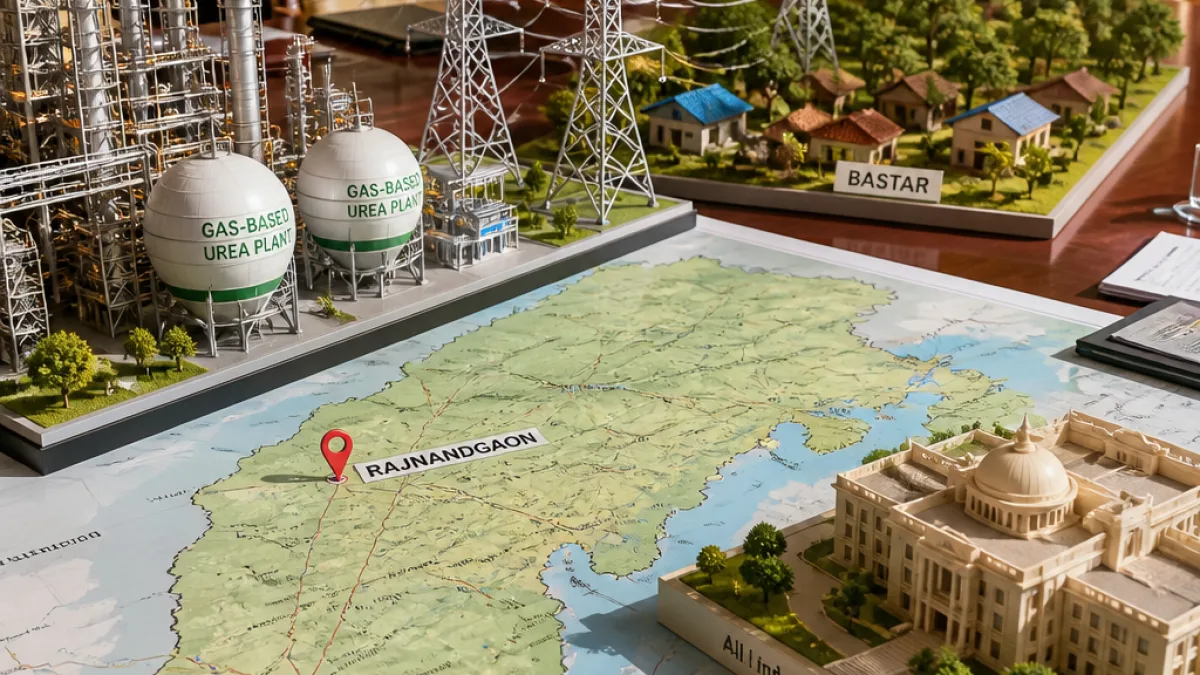
According to a statement issued by the state government, the chief minister sought early Central approval for a proposed ₹10,500 crore gas-based urea plant at Rajnandgaon. The state has completed land allocation and obtained required clearances at the state level, the release said. The project is intended to ensure regional fertiliser availability for farmers and to stimulate local industrial activity.
Sai also requested special Central assistance to connect 461 remote and security-sensitive villages — largely in the Bastar region — to the permanent electricity grid. The statement noted these habitations currently rely on off-grid systems because of past geographical and security constraints. Bringing them onto the main grid is cited as essential for improving healthcare, education and livelihood opportunities in those areas.
In addition, the chief minister asked the Centre to consider establishing an All India Institute of Ayurveda (AIIA) in either Raipur or Bastar, stressing the state’s traditional medicine practices and the local availability of medicinal plants. The government said a national-level institute would help advance research, expand healthcare options and foster regional economic benefits linked to medicinal plant cultivation.
Updates under the ‘Bastar Vision’
Besides the three formal requests, Sai briefed the prime minister on progress under the state’s ‘Bastar Vision’. The statement highlighted several operational and social indicators:
- Reopening of 421 closed schools
- Health screenings conducted for 34 lakh individuals
- Progress on the Jagdalpur–Raoghat railway line
- Recent investment proposals totalling ₹8 lakh crore following the new industrial policy
| Item | Reported Figure / Status |
|---|---|
| Closed schools reopened | 421 |
| People screened (health) | 34 lakh |
| Investment proposals (post-policy) | ₹8 lakh crore |
| Remote villages proposed for grid connection | 461 (primarily Bastar) |
Why these requests matter for Chhattisgarh
The proposed ₹10,500 crore urea plant, if cleared and implemented, would be among the state’s largest industrial projects. State-level clearances and land allocation being complete reduces one set of hurdles, but Central nods — including environmental and project-specific approvals, financing support and possible fuel linkages for a gas-based facility — will determine the timeline and scale.
Electrifying the 461 remote, security-affected villages in Bastar seeks to address a long-term development deficit in a region that has faced insurgency-related disruption. The shift from off-grid sources to the main grid could improve delivery of public services, enable cold chains for health and agriculture, and expand opportunities for small enterprises.
The proposal for an AIIA links healthcare infrastructure to local strengths: traditional medicinal knowledge and raw material availability. A national institute could foster formal research, training and market development for medicinal plants, the statement said.
Next steps and broader implications
The chief minister’s meeting with the prime minister was primarily a platform to secure Central partnership on these flagship initiatives. Timelines, funding commitments and the detail of approvals — particularly for the urea plant and grid-extension in sensitive areas — will depend on follow-up inter-governmental processes and ministries involved.
State officials framed the discussions as part of a wider push to integrate Bastar’s development with mainstream infrastructure and investment flows. The government’s release did not provide an immediate response from the Prime Minister’s Office on the requests or indicate any provisional approvals.
The chief minister’s presentation to the prime minister marks a concentrated effort to convert policy announcements and state-level clearances into projects with Central support and resources. Observers will watch for formal communications from Union ministries and subsequent steps on project sanctioning and implementation.
Reporting from Raipur.